 ultimate-guide
How to Buy International Property Step by Step
Quick Summary
To buy international property, first decide its purpose, set a total budget covering purchase and transaction costs, and choose a destination. Then confirm foreign ownership rules, hire an independent local lawyer, and plan your financing and currency transfer.
- Decide the property's primary purpose first, since retirement, rental and holiday homes call for different locations and due diligence.
- Budget the total cost, including purchase price, transaction costs, legal fees, renovation and running costs.
- Confirm foreign ownership rules, since restrictions can apply by location, land type and ownership structure.
- Hire a local real estate lawyer who acts for you, not the seller or the agent.
- Budget the purchase in your home currency and add a buffer for exchange-rate movement before completion.
Table of Contents
- Start With Your Goals, Budget and Destination
- Legal Requirements for Foreign Property Buyers
- Financing International Real Estate: Cash, Local and Home-Country Mortgages
- Buying Property Abroad Hidden Costs You Need to Budget For
- Your Purchase Timeline and Document Checklist, Then Book Your Next Step
- Frequently Asked Questions
How to Buy International Property Step by Step
Last Updated: October 31, 2026
Start With Your Goals, Budget and Destination
A retirement home, a rental investment and a holiday retreat call for different locations, budgets and due diligence.
Destination follows from purpose. To compare options, see our ranking of the best countries for retirement by visa, cost and care.
Once you have a shortlist, test it against your budget. Set a ceiling for each candidate country and treat anything above it as out of scope, however attractive the listing.
Legal Requirements for Foreign Property Buyers
Foreign ownership law is where international purchases most often stall, because rules are set at national level and sometimes at regional or municipal level too. For one market's specifics, see the South African property buyers guide. Buyers in the same country can face different requirements depending on location, land classification and ownership structure. Confirm the position for your specific destination and property before committing to a search area.
Foreign Ownership Rules and Restrictions
Ownership rules fall into a few recognizable patterns, and knowing which pattern applies to your destination tells you what to ask your lawyer.
- Unrestricted freehold. Some markets treat non-resident buyers much like residents for residential property; the main friction is administrative, tax registration, a local tax number, bank account setup, rather than a legal bar.
- Restricted freehold. Other countries cap foreign ownership of land near borders, coastlines or agricultural zones, or require government or military approval for certain parcels. A property that looks ordinary on a listing portal can sit inside a restricted zone.
- Leasehold-only or quota-based ownership. Some destinations let foreigners hold long leases (often 30 to 99 years) or buy within a capped share of a building, with the land remaining with a local owner or the state.
- Company or trust structures. Where direct ownership is limited, buyers sometimes hold through a locally registered company or trust. This can solve the ownership question but usually adds annual filing, accounting and tax obligations, and can change how the property is treated on inheritance and resale.
Check whether the rules apply differently to freehold, leasehold and company ownership, because each structure carries different tax and inheritance consequences. A structure efficient for a rental investment can be costly for a family retreat that will eventually pass to heirs.
Hiring an Independent Local Lawyer
Engage a local real estate lawyer who acts for you, not the seller or the agent. Independence matters: a lawyer paid by the seller has a conflict of interest. Ask for written confirmation of who they represent and how they are paid, and confirm the engagement letter names you as the client.
Your lawyer should run a defined set of checks before you sign anything:
- Title and ownership records. Confirm the seller is the registered owner, the title is clean, and no mortgage, lien or third-party claim attaches to the property.
- Encumbrances and debts. Confirm there are no outstanding property taxes, utility arrears or service charges that transfer with the property.
- Planning and zoning. Confirm the property's permitted use and that any extensions, pools or outbuildings were built with the required permits. Unpermitted construction is a common source of post-closing disputes.
- Cadastral or registry match. Confirm the physical boundaries and registered description match, which catches boundary and access disputes before they become yours.
- Transfer mechanics. Ask them to walk you through each stage, preliminary agreement, deposit, conditions, completion, registration, before you sign, and to explain which stage is binding and which is refundable.
Ask for the lawyer's fee structure in writing, including disbursements and any other charges, so the legal cost appears in your budget rather than arriving as a surprise at closing.
Financing International Real Estate: Cash, Local and Home-Country Mortgages
You generally have three routes: paying cash, borrowing from a local lender, or borrowing from a bank in your home country. Each has trade-offs in interest rates, documentation, and exchange-rate exposure, and the right choice depends as much on your currency position as on the interest rate.
Cash, Local Mortgages, and Home-Country Mortgages Compared
Cash. A cash purchase is simplest and avoids lender conditions, but it ties up capital and leaves you exposed to the exchange rate on the full purchase price.
Local mortgage. Local mortgages can be harder to obtain as a non-resident.
Speak to a lender in each market early, because approval can take weeks and a financing condition in your offer needs a realistic deadline.
Currency Transfer Strategy and Exchange-Rate Risk
This is the part most guides skip, and it is where international buyers lose money quietly.
A common pattern is to separate the transfer from your everyday bank. Compare the all-in cost of any transfer route, since providers differ in how they build their rate and fees. Ask for the all-in cost, rate plus fee, rather than comparing headline fees.
Manage the timing risk deliberately:
- Spot transfer. You convert the full amount on one day. Simple, but you accept whatever the rate is that day.
- Forward contract. You lock in a rate today for a transfer that settles on a future date, which is useful once you have a signed contract and a known completion date.
- Staged transfers. You convert in tranches as payments fall due, deposit, interim payment, completion, which spreads the rate risk across the transaction.
Ask your lawyer and transfer provider to confirm payment instructions in writing and verify them through a second channel before you send funds. Payment-instruction fraud, where a fraudster intercepts an email and substitutes bank details, is one of the most common ways international buyers lose money, and it is preventable with a phone call to a known number.
Buying Property Abroad Hidden Costs You Need to Budget For
The purchase price is rarely the full cost.
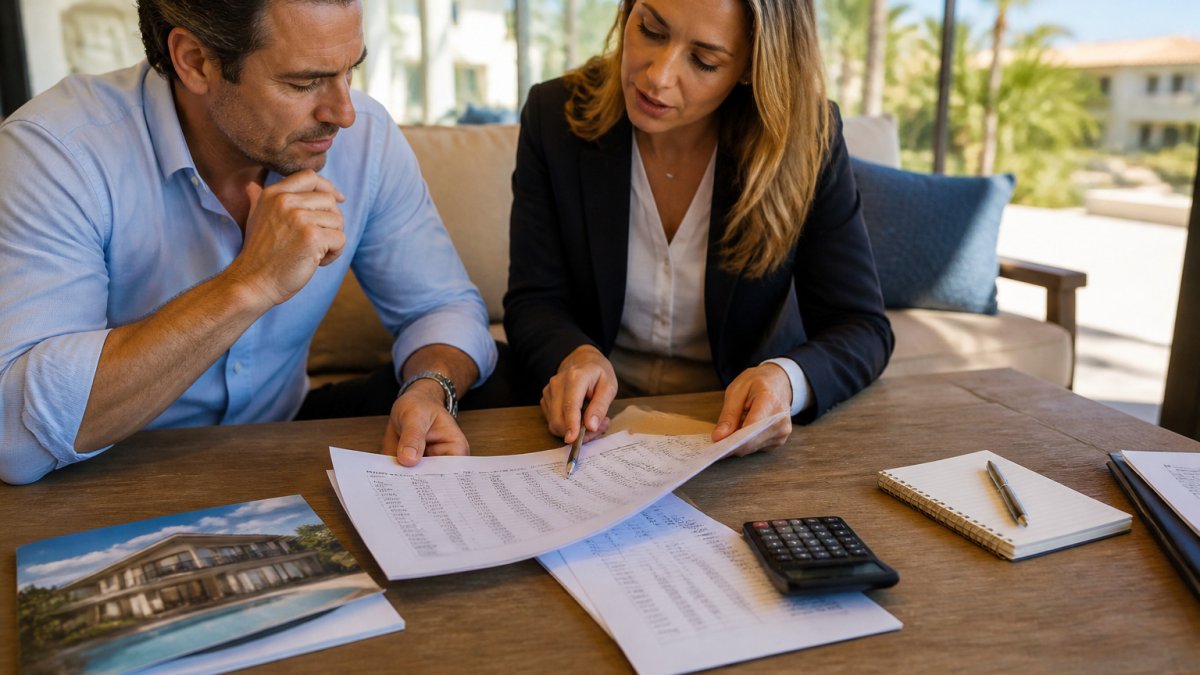
Ongoing costs matter too: annual property taxes, insurance, maintenance, property management if you rent the home out, and utilities.
Hold a contingency of at least several months of running costs in reserve.
The purchase price is only part of what you will pay, so the main cost categories are worth comparing side by side.
| Cost type | What it covers | Note |
|---|---|---|
| Transaction costs | Transfer taxes, notary or legal fees, agent commission, valuation, registration | Exact amounts differ by country |
| Annual property taxes | Recurring tax on the property | Confirm rate with your lawyer |
| Running costs | Insurance, maintenance, utilities | Easy to underbudget in year one |
| Property management | Managing the home if you rent it out | Only applies to rental use |
| Contingency reserve | Buffer for running costs | Hold at least several months |
Your Purchase Timeline and Document Checklist, Then Book Your Next Step
Most international purchases take several months from offer to completion. Allow time for due diligence, financing approval and the legal transfer, and build in buffer for delays.
Gather these documents early:
- Valid passport and proof of identity
- Proof of funds or source of wealth documentation
- Tax identification number in the destination country
- Bank references and, if financing, a mortgage agreement in principle
- Signed power of attorney if you cannot attend in person
Keep copies of every document and every communication with the seller and agent.
When you are ready to move forward, You can contact the business with questions about your specific situation before booking your next step. Use our subject access request form to send your questions.
Frequently Asked Questions
Can US citizens buy property overseas?
Yes, US citizens can generally buy property overseas in most countries, but the rules differ widely. Some countries allow full foreign ownership, others restrict foreigners to certain property types or regions, and a few limit ownership entirely. Start by checking the destination country's foreign ownership rules with a local real estate attorney, since those rules determine what you can legally buy, how title is held, and whether you need a local entity or residency to complete the purchase.
What are the hidden costs of buying property abroad?
Hidden costs often include transfer taxes, notary or registration fees, legal and agent fees, property valuation charges, and currency conversion losses. Some countries also levy annual property taxes or capital gains taxes on resale. Ask for an itemized estimate of all closing costs before making an offer, and build a contingency of several percent on top of the purchase price so unexpected charges do not derail the deal.
Can I get a loan to buy international property?
You can often finance an international purchase through a local mortgage in the destination country, a mortgage from your home country secured against your existing property, or a specialist overseas lender. Lending criteria, loan-to-value ratios and interest rates vary by country and by your residency status and income documentation. Compare several lenders, confirm exchange-rate terms, and ask how repayments will be affected if the local currency moves against your home currency.
Do I need a lawyer when buying international real estate?
Yes, an independent local real estate lawyer is strongly recommended. The lawyer should be qualified in the destination country, work for you rather than the seller or agent, and check title, ownership records, encumbrances, planning permissions and the purchase contract. Avoid relying solely on the agent or seller's representatives for legal review, particularly when you are buying remotely.